The unified operating
fabric for
water utilities.
One layer on top of the SCADA, sensors, geotechnical PDFs, and GIS you already run — for water utilities, dam operators, and water-resource agencies. Every answer carries a citation back to its source.
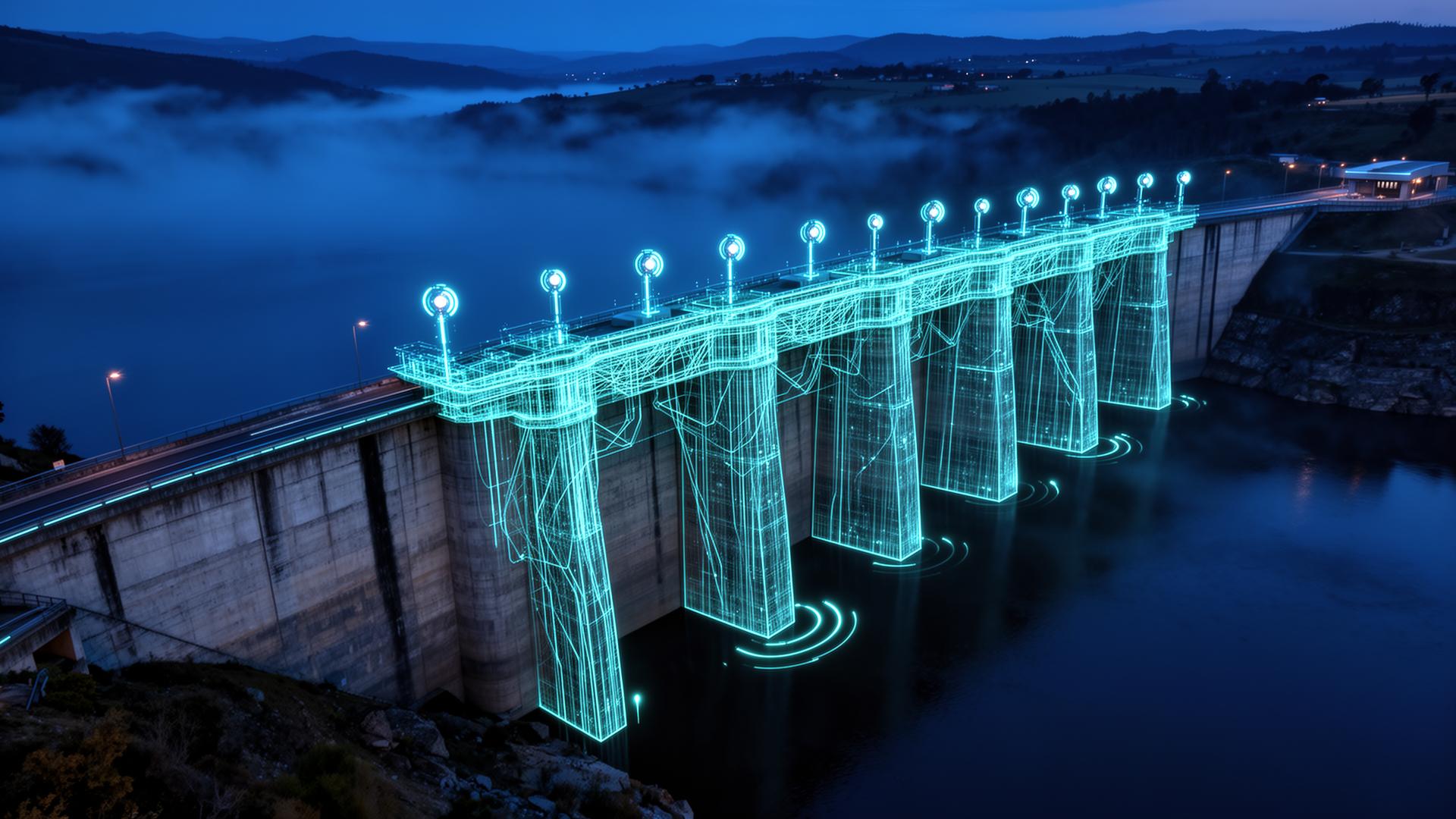
Three pillars, one operating layer.
Each pillar solves a specific problem the others cannot solve alone. Together they cover the full path from sensor reading to auditable decision.
Hydrology and dam safety, fused.
The pillar that holds two solutions — Dam Safety and Hydrology Forecast & Decision Support. Forecast streamflow on a 72-hour horizon; resolve dam displacement to 0.1 mm. The numbers stop being approximate.
Bridge the SCADA you already run.
The Intelligent Control Engine (ICE) is a read-only overlay on Ignition, Wonderware, Modbus, DNP3, and proprietary historians. ICE rationalises alarms, prioritises by criticality, and forecasts failures up to 14 days out. Nothing in the existing stack changes.
The reasoning layer, across all three.
Syfter is the agent of agents that sits over Core Intelligence and ICE — named specialists for Hydrology, Compliance, Maintenance, Geotech, and Procurement. Every answer carries a Citation Path back to the source document, the PDF page, or the sensor ID.
From reservoir to control room.
One operating fabric across every asset you run.
Water utilities run on data that was never built to talk to itself. SCADA stacks from different decades. Geotech reports stuck in PDFs. Release schedules living in spreadsheets. Sensors arriving by the second. AquaSys AI™ sits on top of all of it as a single operating fabric, so the question a control room asks at 2 a.m. has a traceable answer by 2.00.02.
The most critical resource. The most fragmented data.
A pump failure is rarely the first warning. The first warning is usually buried, in a PDF a former engineer wrote, a sensor reading from a sister station, a maintenance note from last winter. The data exists. It just lives in places that do not speak to each other.
What looks like an alert problem is almost always a translation problem.
Alarm fatigue
Operators see thousands of alerts a week, and the vast majority are noise. The signal is in there. It is the time to find it that has gone.
Reactive maintenance
On a $400M asset base, unplanned downtime runs about $3.46M a year. Most of it is a forecastable failure that was noticed too late.
Knowledge trapped in PDFs
Decades of geotechnical reports, design memos, and inspection notes sit in document folders. The institutional memory is real. It is just not searchable in the moment it is needed.
Lost every year to avoidable water loss and leakage across U.S. utilities alone.
Spent every year repairing roughly 240,000 U.S. water-main breaks — many of them preventable with earlier detection.
From your data to a cited answer.
Five steps, on the systems you already run. Nothing is ripped out; AquaSys AI™ layers on top and reads.
Connect
Legacy SCADA (the control system that runs the plant), IoT sensors, geotechnical PDFs and GIS — read-only.
Integrate the Twin
Your Digital Twin — your live, data-fed model of one asset — plugs in as a single source of truth.
Reason
Three pillars and five named agents forecast, rationalise and decide.
Cited answer
Every output carries a Citation Path: the trace back to the sensor, the PDF page, the regulation.
Outcome
Fewer false alarms, millions in avoided downtime, audit-ready compliance.
Dialogue with the data. No black boxes.
Most water AI returns an answer. Syfter returns the answer and the audit trail behind it. Ask why a piezometer reading drifted, and you get the reading, the historical baseline, the maintenance note from 2019, and the PDF page where the original threshold was set.
Built for measurable outcomes.
We’re early, and we publish results as our pilots produce them — verified, on your asset, never borrowed. Here is what a deployment is designed to deliver.
Quieter control rooms
Alarm rationalisation clusters and ranks events by criticality, so operators see the actionable few instead of the noisy many.
Earlier warning
Structural and equipment anomalies are designed to surface days before they reach an action level — time to plan, not just react.
Audit-ready by default
Every recommendation traces back to its source, so compliance reports and audit logs come out of the work, not on top of it.
Every pilot agrees its success criteria up front and is measured against them — not against marketing claims.
Size it for your assets.
You have seen the macro losses. Now make it concrete: plug in your asset base, downtime, and alarm load, and the calculator estimates avoided downtime, labour saved, predictive gain, and a three-year ROI.
Procurement-grade by default.
The questions a security review asks first, answered up front. Your data stays yours; AquaSys AI™ only ever reads.
Sovereign deployment
Runs inside your own network — no operational or sensor data leaves your environment.
AES-256, end to end
Encryption in transit and at rest, with RBAC and your existing SSO or SAML.
Read-only overlay
AquaSys AI™ reads from the systems you run; it never writes to or controls them.
Built to scale
Sub-2-second inference across 100,000 live tags, to a 99.9% uptime target.
Intelligence for the water systems the world depends on.
AquaSys AI™ exists to safeguard the world’s water systems — giving every utility a unified, auditable intelligence layer that turns fragmented data and human expertise into decisions that earn trust, in real time. The software is the tool. The mission is older than the software.
Read the founding charter→The questions teams ask before a pilot.
What is AquaSys AI™?
+AquaSys AI™ is a unified operating fabric for water utilities, dam operators, and water resource agencies. It sits on top of existing SCADA, IoT sensors, geotechnical PDFs, and GIS layers as a single intelligence layer. Three pillars cover the work: Core Intelligence (hydrology and dam safety), the Intelligent Control Engine (SCADA overlay, alarm rationalisation, predictive maintenance), and Syfter AI (the agent of agents reasoning layer). Every answer the system produces carries a Citation Path back to its source.
How does AquaSys AI™ integrate with existing SCADA?
+As a read only overlay. AquaSys AI™ connects through OPC UA, MQTT, Modbus, and DNP3, and supports Ignition, Wonderware, and proprietary historians. Nothing in the existing stack is modified. There is no downtime during onboarding. The principle is simple: bridge what works, do not replace it.
Is AquaSys AI™ compliant with FERC Part 12D and ICOLD?
+Yes. The Compliance Agent surfaces FERC Part 12D and ICOLD protocols directly, and every recommendation it makes carries a Citation Path back to the source regulation or document. Automated state dam safety reports, water accounting reports, and audit trails are produced as standard outputs.
How long does a pilot take?
+30 days. One critical asset, with your existing Digital Twin integrated into AquaSys AI™. The pilot is scoped to a single asset on purpose, to limit organisational risk and produce a clean, measurable outcome. Expansion follows pilot validation, not the other way around.
How does Syfter avoid hallucinations?
+Every Syfter response carries a Citation Path back to the source document, the specific PDF page, or the sensor ID it relied on. The architecture is multi modal RAG, which means the agent grounds its answers in real source material rather than in model weights. If a citation does not exist, Syfter says so.
Where is the data hosted?
+Sovereign deployment is the default. AquaSys AI™ runs in the customer VPC or on premise, with AES 256 encryption at rest and in transit, RBAC, and SSO or SAML integration. No customer data is required to leave the customer environment. NFR 01 in the technical spec covers this in full.